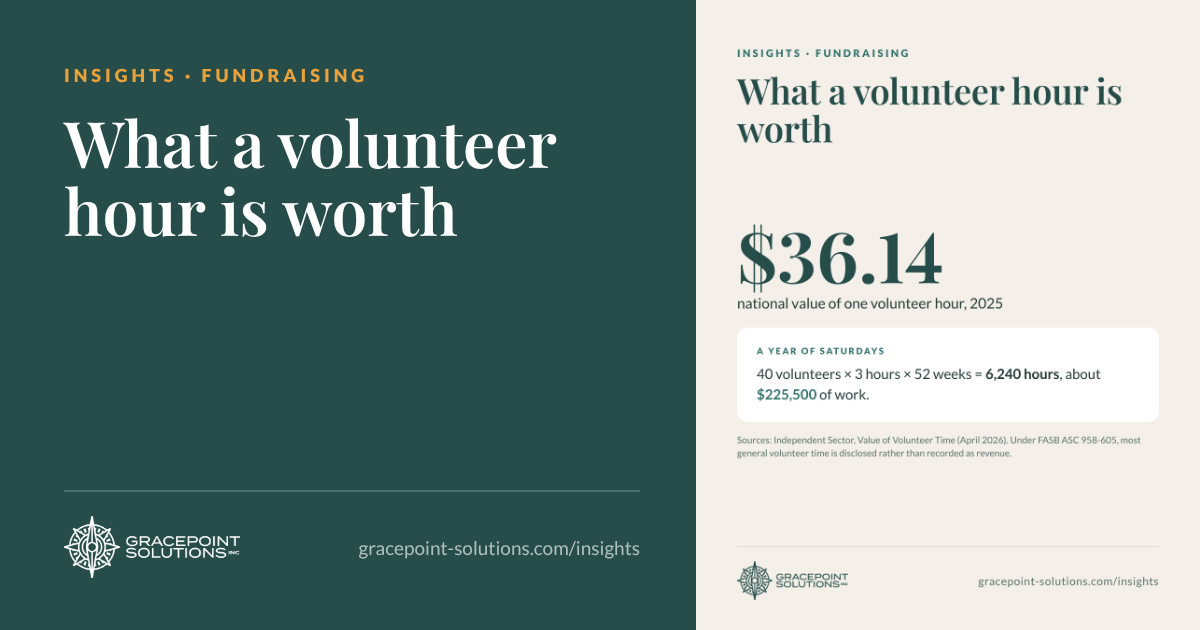
Independent Sector puts the value of a volunteer hour in the United States at $36.14 for 2025, up 3.9% from $34.79 the year before. The figure, released on April 21, 2026, is built from federal wage data plus an estimate of benefits. Independent Sector also publishes a figure for each state, which is handy for local grant applications.
For a pantry, that number adds up quickly. Forty volunteers giving three hours every Saturday for a year contribute 6,240 hours. At $36.14 an hour, that is about $225,500 worth of work.
What the books can show
Accounting standards apply a narrower test for what counts as revenue. Under FASB’s standard for not-for-profits, ASC 958-605, contributed services are recorded only if they "create or enhance nonfinancial assets," or if they "require specialized skills, are provided by individuals possessing those skills, and would typically need to be purchased if not provided by donation." The standard lists accountants, architects, carpenters, doctors, electricians, lawyers, nurses, plumbers and teachers as examples.
The volunteer sorting cans on a Saturday morning is doing essential work, and that work usually doesn’t meet either test. The accountant who prepares your Form 990 for free does. So does the crew that helps build a new storage room, even if no one on it is a professional, because their work creates an asset.
What the notes still tell
The same standard asks for something more generous in the footnotes. An organization that receives contributed services "shall describe the programs or activities for which those services were used, including the nature and extent of contributed services received," according to ASC 958-605-50-1B. It encourages organizations to disclose the fair value of services they don’t record as revenue, when that’s practical, and names the kinds of information that count: "the number and trends of donated hours received or service outputs provided by volunteer efforts."
That description is required whether or not any services appear as revenue. Every organization that runs on volunteers already has a place in its financial statements to tell their story.
Where the hours earn their keep
Outside the audited statements, volunteer time can do even more. Grant applications often ask about in-kind support. Board reports and annual letters are stronger with a real count of people and hours, and a thank-you note that says "you and 39 friends gave 6,240 hours this year" lands differently than a form letter. After a declared disaster, FEMA lets public applicants credit documented volunteer labor toward their share of recovery costs, as we described in What FEMA Will Count.
Each of those uses depends on records kept at the time: who served, for how long and what they accomplished.
GracePoint captures what volunteers accomplish as they work. Every item scanned, valued and sent home with a family becomes part of a timestamped record, the kind of service output the accounting standard describes. Paired with a simple sign-in sheet for hours, it tells the whole story of a Saturday shift.
What would your volunteers say if they saw, in one number, everything their Saturdays made possible?
Sources: Independent Sector, Value of Volunteer Time (April 2026); FASB ASC 958-605-25-16 and 958-605-50-1B, as reproduced in PwC’s Not-for-profit entities guide; FEMA Public Assistance donated resources guidance.
See real-time inventory visibility in action
GracePoint Solutions deploys in under 30 minutes — no IT team required. Book a demo to see what coordinated visibility looks like for your network.
Book a Demo