When disaster strikes, charities are often the first to show up. Church gyms become shelters, warehouses fill with donated water and diapers, and volunteers work shift after shift to get supplies to the people who need them.
All of that generosity has a value that can come back to the community in a very practical way.
After a federally declared disaster, FEMA's Public Assistance program reimburses state, tribal and local governments, and some private nonprofits, for at least 75 percent of eligible recovery costs. The remaining share, usually 25 percent, falls on the applicant. For a county that has just spent weeks on sheltering, feeding and cleanup, finding that 25 percent can be hard.
The good news is that donations can help. FEMA lets applicants use the value of donated resources, including volunteer labor, equipment, and donated supplies and materials, to offset their share of eligible work. The goods charities receive and hand out in the first days of a response are exactly that kind of resource.
What the records need to show
FEMA's donated resources guidance is specific about documentation:
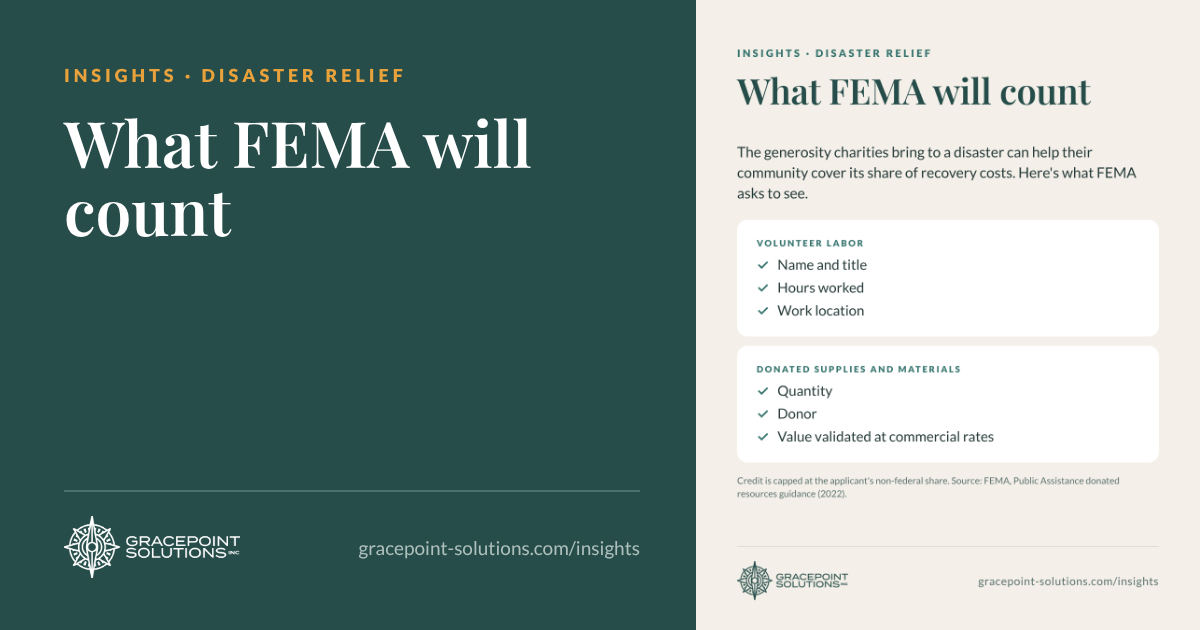
- Volunteer labor: sign-in sheets with each volunteer's name, title, hours worked and work location. Labor is valued at the straight-time rate of a similarly qualified paid worker.
- Donated supplies and materials: quantities, who donated them and invoices that support the value claimed, at current commercial rates up to fair market value.
The total credit can't exceed the applicant's non-federal share, and it's filed by the applicant, usually the county or state, with charities' records supporting the claim.
Making it easy in the busiest week of the year
Nobody wants to stop a disaster response to fill out forms, and nobody should have to. The trick is to let the records build themselves as the work happens.
That's how GracePoint works. A donated item scanned at intake carries a timestamp, a category, an estimated value and, where known, the donor. When it goes out the door, the scan records where it went. Volunteers who check in at a site leave a record of when they arrived and where they served. Put together, those entries look a lot like what FEMA asks for, and they're ready when the county emergency manager calls.
A little preparation now goes a long way. The best step a distribution organization can take before the next disaster is a short conversation with its county emergency manager about what intake and distribution records the county would like to receive. Then the records can be in the right shape from day one.
Every pallet of donated water is an act of kindness. With good records, it can also help a community recover.
If you'd like help getting your network ready before the next disaster, we'd love to talk. Get in touch.
Sources: FEMA, “Donated Resources Can Help Offset Public Assistance Project Costs” (February 2022); FEMA Public Assistance Donated Resources policy.
See real-time inventory visibility in action
GracePoint Solutions deploys in under 30 minutes — no IT team required. Book a demo to see what coordinated visibility looks like for your network.
Book a Demo