When a crate of donated romaine arrives at a church pantry, it carries a long history: the farm that grew it, the packer that cooled it, the distributor that trucked it and the grocer that couldn’t sell it in time. Starting in 2028, federal rules will require most of the businesses in that chain to write that history down. The pantry is not one of them.
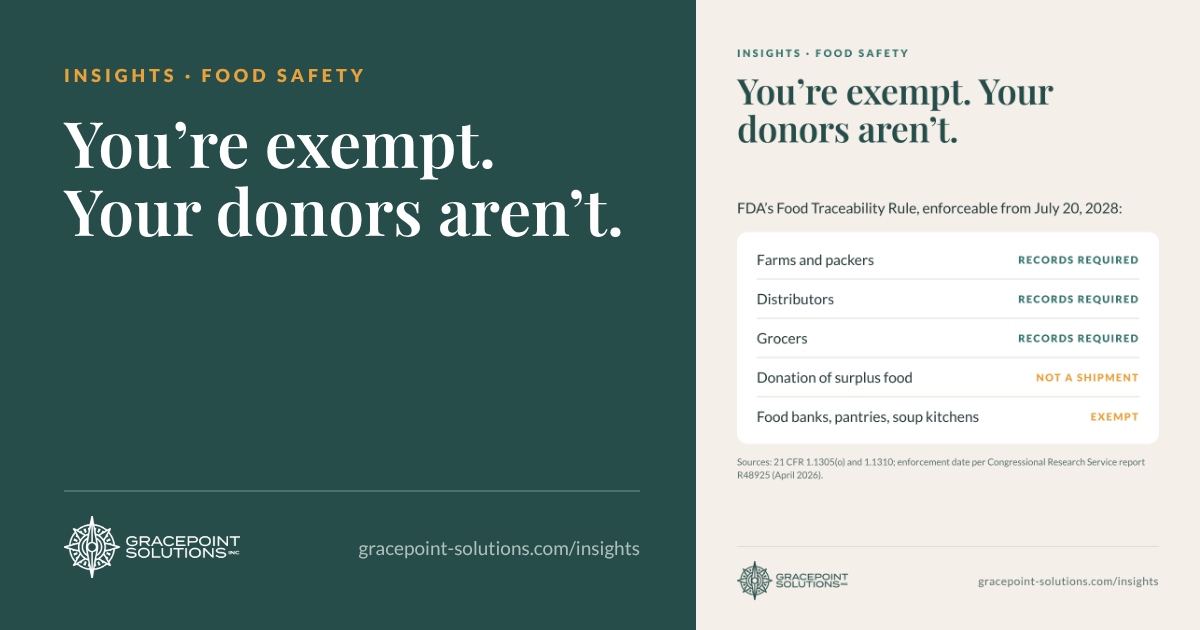
The Food and Drug Administration finalized its Food Traceability Rule in November 2022 under section 204 of the Food Safety Modernization Act, which is why people in the food business call it FSMA 204. It requires companies that grow, pack, ship or receive certain foods to keep detailed records and hand them to FDA within 24 hours of a request, so investigators can trace contaminated food back to its source. The original compliance date was January 20, 2026. Congress has since barred FDA from enforcing the rule before July 20, 2028, through the fiscal 2026 appropriations law, according to the Congressional Research Service.
What the rule says about charities
The exemption is one line long. Section 1.1305(o) of the rule reads: "This subpart does not apply to nonprofit food establishments." FDA defines that term to include "central food banks, soup kitchens, and nonprofit food delivery services," along with other charitable organizations that provide food to the public, as long as they meet the terms of section 501(c)(3) of the tax code.
The rule also says a donation is not a shipment. Its definition of shipping excludes "the donation of surplus food." When a grocer gives its unsold eggs to a food bank, that handoff is not a shipping event under the rule, and the food bank on the receiving end is exempt.
For the people running pantries, that is welcome news. A volunteer-run site does not need to assign traceability lot codes or prepare for an FDA records request.
Where the donors fit in
The businesses upstream are covered. A grocer that receives a pallet of tomatoes must record the traceability lot code, the quantity, the product description, the previous source, where and when the food arrived, and the reference number on the delivery paperwork. Those records follow the food all the way to the grocer’s back door.
The foods on FDA’s Food Traceability List are ones pantries see every week: leafy greens, tomatoes, cucumbers, melons, fresh herbs, shell eggs, soft cheeses, nut butters, finfish, shellfish and ready-to-eat deli salads.
So the federal record runs right up to the moment of generosity and then stops. If investigators trace an outbreak to a lot of bagged spinach, the grocer can show which lot it received and when it arrived. Whether anyone can say which pantry shelves that spinach reached depends on what the charity chose to write down.
What a good record looks like anyway
The records that help most during a recall are simple: what came in, from whom, on what day, and where it went next. A pantry that keeps those four things can answer a call from its donor or the local health department in minutes.
That is the record GracePoint builds as volunteers work. Each donated item is scanned with a phone at intake, identified, dated and linked to the donor it came from. As it moves to a distribution point or a household, each handoff is logged, and recipients’ personal information stays out of the record.
It also makes a pantry an easier place to give to. A grocery manager deciding where to send surplus produce has every reason to favor a partner that can say, item by item, where it went.
If a recall notice reached your pantry tomorrow morning, how long would it take to know whether that lot was on your shelves?
Sources: FDA Food Traceability Rule, 21 CFR 1.1305(o), 1.1310 and 1.1345; Congressional Research Service, "The Food and Drug Administration’s Food Traceability Rule: Overview and Issues for Congress" (R48925, April 2026).
See real-time inventory visibility in action
GracePoint Solutions deploys in under 30 minutes — no IT team required. Book a demo to see what coordinated visibility looks like for your network.
Book a Demo