Every closet clean-out ends the same way: a bag of sweaters, a couple of pairs of jeans and a winter coat, dropped off at a charity with the best of intentions.
Some of those clothes become exactly what a family needed for the cold months. Others cost the charity hours of sorting and shelf space before they leave by the back door.
The scale of it
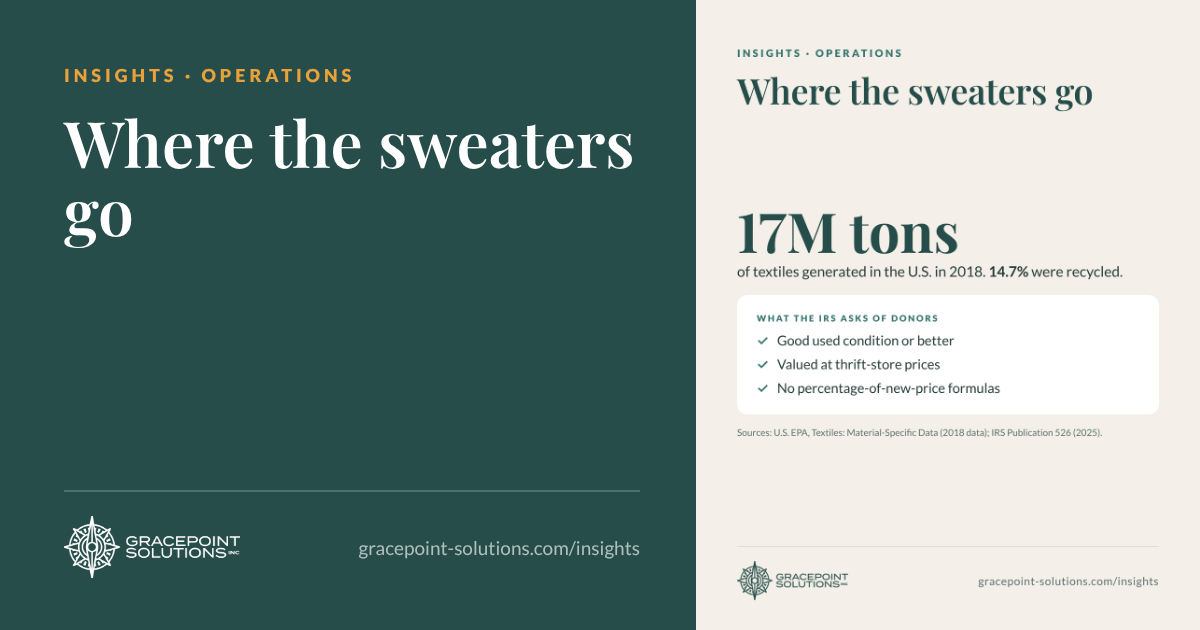
The Environmental Protection Agency estimates that Americans generated 17 million tons of textiles in 2018, the most recent year it has published. Only 14.7% were recycled, and landfills received 11.3 million tons. Clothing and footwear on their own had a recycling rate of 13%.
Those figures include clothing that never came near a charity. They also show how much depends on what happens after the drop-off, and how valuable a well-run clothing closet is. Every sweater that finds a second owner stays out of those totals a little longer.
What the IRS asks of donors
Donors have their own reasons to give good items. IRS Publication 526 says: "You can’t take a deduction for clothing or household items you donate unless the clothing or household items are in good used condition or better."
The value is set by the resale market, not the original price tag. In the IRS’s own example, a coat bought for $300 three years ago, when similar coats sell for $50 at a thrift store, is worth $50. "There are no fixed formulas or methods for finding the value of items of clothing," the publication notes.
The same condition rule covers household items such as furniture, small appliances and linens. For those, the publication says formulas, "such as using a percentage of the cost to buy a new replacement item," aren’t acceptable for setting value. There is one exception for items in poorer shape: a single item valued at more than $500 can still be deducted with a qualified appraisal and Form 8283, Section B.
Tax situations vary, so donors should confirm the details with their own tax advisor.
What charities can do at the door
Clear intake standards help everyone:
- Publish a wish list, by season and size, and update it often. Coats are most useful in October, not April.
- Tell donors what you can’t use, and where those items can go instead.
- Sort at intake, so unusable items leave the same day instead of taking up space.
- Give donors a receipt that describes what they gave.
GracePoint keeps intake quick for volunteers. A photo of each item returns a suggested category and an estimated value, and the record follows the item until it goes home with a family. Coordinators can see what’s coming in and what’s moving out, and donors can hear where their coat ended up. It also gives a clothing closet numbers to share with a funder, like how many coats went out in November.
What would your volunteers do with the hours they now spend sorting donations you can’t use?
Sources: U.S. Environmental Protection Agency, "Textiles: Material-Specific Data"; IRS Publication 526 (2025).
See real-time inventory visibility in action
GracePoint Solutions deploys in under 30 minutes — no IT team required. Book a demo to see what coordinated visibility looks like for your network.
Book a Demo