Every can on a pantry shelf represents someone's generosity, and every can that reaches a family represents a volunteer's work. Together, that adds up to something of real value, often far more than a pantry's financial statements show.
A pantry that hands out 40,000 pounds of donated food a year has done something remarkable. Yet because donated goods are hard to count and harder to price, small organizations often leave them off their books entirely, or record one round number at year end. To a funder reading those numbers, the pantry looks a fraction of its real size.
What the accounting rules ask for
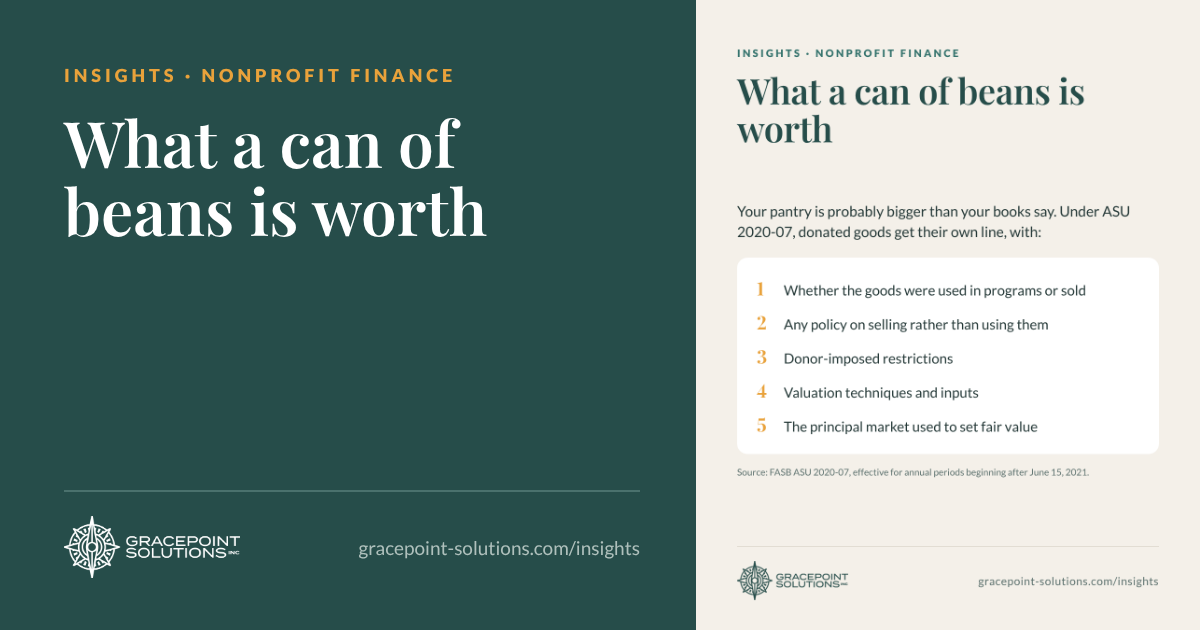
Since 2021, the rules have asked for more detail about donated goods. The Financial Accounting Standards Board's ASU 2020-07, effective for annual periods beginning after June 15, 2021, asks not-for-profits to:
- report contributed nonfinancial assets on their own line in the statement of activities;
- break them out by category;
- say whether each category was used in programs or sold;
- describe any donor restrictions; and
- describe how each value was arrived at, including the market used.
For a food bank with a finance team, that's a yearly exercise. For a church pantry run by volunteers, it raises a question nobody has time to answer: what is a donated can of beans worth, and how do you know?
Getting it right, in both directions
Regulators care that values are fair. The California Attorney General's office has described common ways gift-in-kind reporting can mislead, including inflated values, value assigned to items that have none, and goods a charity never owned or controlled.
For small organizations, the more common problem is the opposite: their generosity goes uncounted. That shows up in grant applications that report only cash spending. It shows up when a county wants to count donated goods toward a disaster cost share and finds no value on record. And it shows up when donors who gave groceries instead of money don't appear in the pantry's own account of who supports it.
Value it when it arrives
Both problems have the same simple fix: record a value when each item comes in the door, based on what it sells for in a real market, and keep that value attached to the item as it moves.
That's what GracePoint's intake scan does. When a volunteer photographs an item, GracePoint identifies it, assigns a category and estimates its value from retail pricing data. Those estimates give an organization's accountant an item-level record to review and approve, instead of a year-end guess.
Imagine walking into your next grant meeting with a clear, documented picture of everything your pantry gave away last year, every can and every case. That's a story worth telling.
If you'd like to see what your donated goods are really worth, we'd love to show you. Get in touch.
Sources: FASB, ASU 2020-07, Not-for-Profit Entities (Topic 958); California Attorney General, “Gifts-in-Kind Donations: How They Can Be Used to Deceive.”
See real-time inventory visibility in action
GracePoint Solutions deploys in under 30 minutes — no IT team required. Book a demo to see what coordinated visibility looks like for your network.
Book a Demo