At a pantry that hands out pre-packed bags, every household goes home with the same groceries. A family that doesn’t eat pork gets the pork. A couple without a working stove gets the dried beans. Some of it gets traded, some gets passed along, and some never gets eaten.
A client-choice pantry works more like a small grocery store. Neighbors walk the shelves, pick what their household will use and leave the rest for someone who will. Researchers at NORC describe full choice simply: the pantry "feels like a mini-supermarket," and neighbors "touch and select their own food."
What happened when pantries made the switch
Beginning in 2021, Feeding America and the Morgan Stanley Foundation funded food banks to help their partner pantries move toward choice. NORC at the University of Chicago evaluated the program with Connecticut Foodshare’s Institute for Hunger Research & Solutions.
In the first year, 28 food banks took part. The share of their partner pantries offering modified or full choice rose from 32% in July 2021 to more than 60% by February 2022.
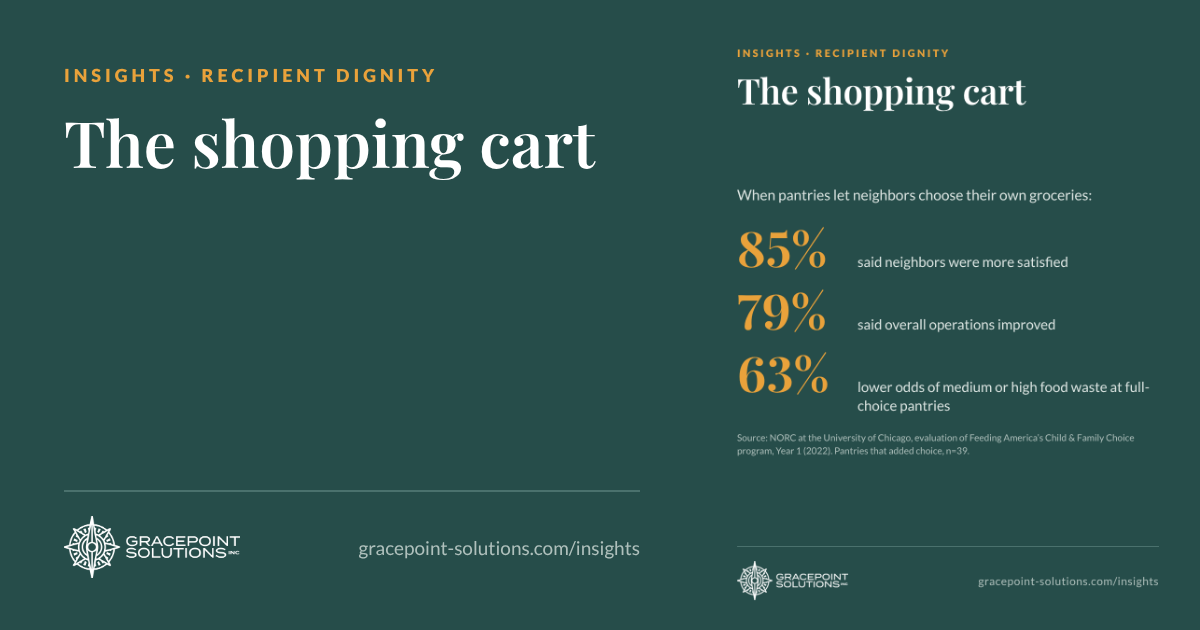
Among the 39 pantries that added choice, 79% said overall operations improved, 85% said neighbors were more satisfied and 77% said their staff and volunteers were happier. Pantries offering full choice had 63% lower odds of reporting medium or high food waste.
The second year brought in neighbors’ own voices through 4,785 surveys. People who shopped at full-choice pantries were significantly more likely to say they always use the food they receive, and less likely to bring home food they didn’t want.
Easier than it looks
The biggest worry pantry leaders named before switching was efficiency. Choice sounds slower, with more shelves to stock and more time per family.
The pantries that made the change found it manageable. Two-thirds said planning took less than a month, and 62% reported little or no added cost once they were up and running. Asked what made the change possible, 84% of pantry leaders named dignity for their neighbors as critical, followed by buy-in from staff and leadership. One pantry leader told the evaluators that "90% of folks, when presented with the choice, would choose to shop."
The research team published its findings in the Journal of Hunger & Environmental Nutrition in December 2023, under a title that says it plainly: "Offering Full Choice in Food Pantries Is Feasible and Improves Pantry Operations."
Keeping count when every cart is different
Choice changes one thing behind the scenes. When every household leaves with a different mix, a count of bags distributed no longer describes what went out the door.
GracePoint records distribution item by item. Volunteers scan with their own phones, and each item a household takes home is logged without storing the family’s personal information, so a pantry can offer choice and still show donors exactly what reached the community. Coordinators can also see which items move fastest when people choose for themselves, which makes it easier to ask donors for what’s needed most.
If your neighbors could choose tomorrow, what would they reach for first?
Sources: NORC at the University of Chicago, evaluation of Feeding America’s Child & Family Choice program, Year 1 report (2022) and Year 2 brief (2023); K.S. Martin et al., "Offering Full Choice in Food Pantries Is Feasible and Improves Pantry Operations," Journal of Hunger & Environmental Nutrition (2023).
See real-time inventory visibility in action
GracePoint Solutions deploys in under 30 minutes — no IT team required. Book a demo to see what coordinated visibility looks like for your network.
Book a Demo