Since 1996, the Bill Emerson Good Samaritan Food Donation Act has given grocers, farmers and restaurants a simple promise. Donate apparently wholesome food in good faith to a nonprofit that gives it away, and you are protected from civil and criminal liability, unless you acted with gross negligence or intentional misconduct.
That promise came with two limits that shaped how charitable food moves to this day. The food had to pass through a nonprofit, and the nonprofit had to give it away for free.
On January 5, 2023, the Food Donation Improvement Act loosened both.
A price that covers the work
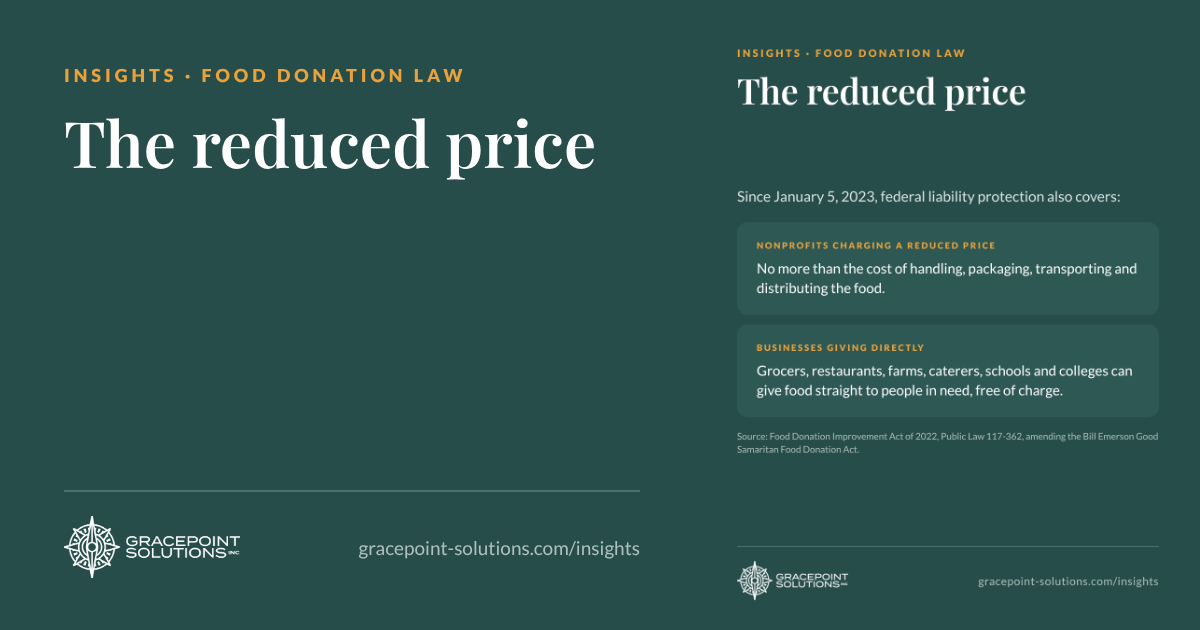
The new law lets a nonprofit charge recipients a "good Samaritan reduced price" and keep its protection. The statute caps that price at the cost of "handling, administering, harvesting, processing, packaging, transporting, and distributing" the food. A pantry or community market can ask shoppers to cover what it costs to get food onto the shelf, and no more.
That opens the door to models many communities have wanted to try: nonprofit grocery stores, social supermarkets and low-cost markets where neighbors pay a small amount and shop with the same choice anyone else has. It also gives a nonprofit a lawful way to recover part of what it spends on trucking, refrigeration and packaging.
Straight to the neighbor
The second change lets certain businesses give directly. The law names nine kinds of "qualified direct donor": retail grocers, wholesalers, agricultural producers, agricultural processors, agricultural distributors, restaurants, caterers, school food authorities and institutions of higher education. Each can now donate food directly to a person in need and keep the same protection, as long as the food is free.
A restaurant can hand its end-of-night trays to neighbors waiting outside. A college dining hall can set out what’s left after dinner for students who need it. The reduced price applies only when a nonprofit is the one distributing; direct donations stay at zero cost.
What the protection still asks
The core conditions are the same as before. Donated food has to be "apparently wholesome" and meet federal, state and local safety standards, even if it has cosmetic flaws or wouldn’t sell at full price. Protection doesn’t reach food handed out with gross negligence or intentional misconduct. And the federal law is a floor, so states can add protection of their own. A quick read of your state’s statute is time well spent.
Knowing your costs
The reduced price works best when an organization knows what its handling costs. That number comes from ordinary operating records: how much food came through the door, how much went out, how many trips the truck made and how much cold storage it took.
Most small pantries have never needed to calculate it, because giving everything away made the question moot. A pantry thinking about a community market will want that answer first.
GracePoint helps with the first half of the math. Volunteers scan each donated item with a phone at intake, and GracePoint identifies it, estimates its value and records where it goes next, so a site can see how much food moves through each week instead of reconstructing it at year end.
What would your pantry look like if neighbors could shop it for the cost of getting the food there?
Sources: Food Donation Improvement Act of 2022, Public Law 117-362 (signed January 5, 2023); Bill Emerson Good Samaritan Food Donation Act, 42 U.S.C. 1791; Natural Resources Defense Council, Emerson Act legal fact sheet (June 2023).
See real-time inventory visibility in action
GracePoint Solutions deploys in under 30 minutes — no IT team required. Book a demo to see what coordinated visibility looks like for your network.
Book a Demo