For a parent standing at a food pantry door without a driver's license, the most important thing that can happen is simple: someone says welcome and hands them groceries.
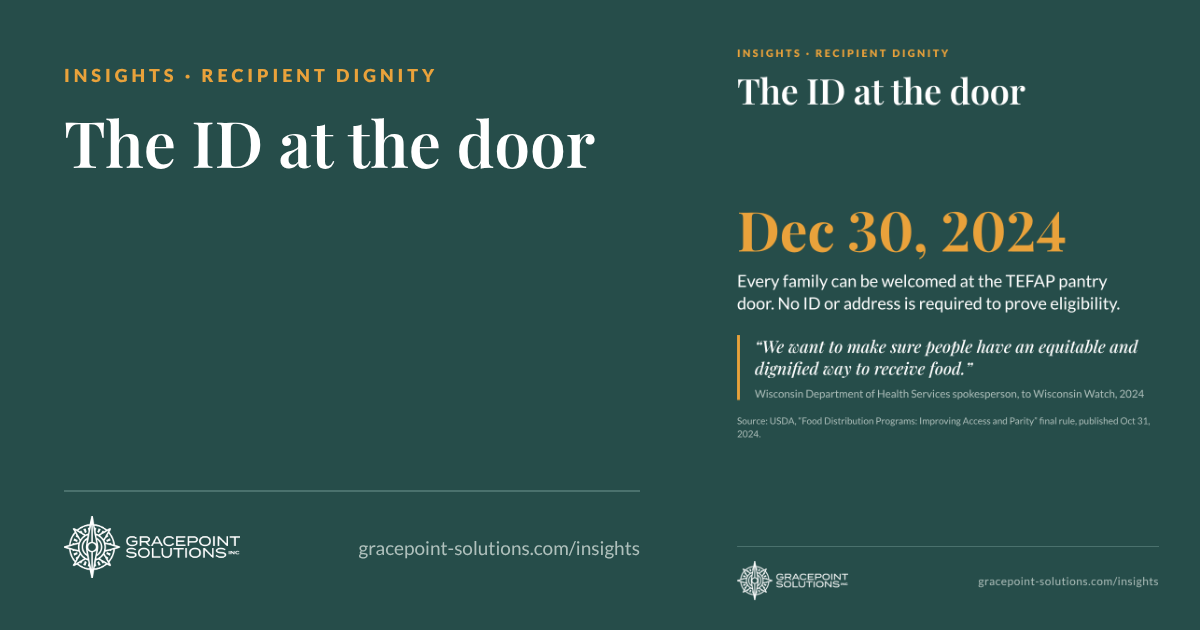
Federal rules now make that easier. Since December 30, 2024, pantries distributing food through The Emergency Food Assistance Program, known as TEFAP, can no longer require a household to show identification or provide an address to prove eligibility. The change came from a USDA final rule, “Food Distribution Programs: Improving Access and Parity,” published October 31, 2024. States may now let households self-declare residency, and local agencies no longer have to keep household addresses on file.
Good news for dignity
Some states were already moving this way. In April 2024, Wisconsin's Department of Health Services told its 265 TEFAP pantries to stop checking IDs and verifying county residence, according to Wisconsin Watch. A department spokesperson explained why: “We want to make sure people have an equitable and dignified way to receive food and we feel like the less information gathering in that regard that's allowable, the better.”
The people ID checks screened out were mostly people in hard circumstances. A 2018 Children's HealthWatch review heard many accounts of people turned away for lacking a state-issued ID. Joli Guenther of the Wisconsin Association for Homeless and Runaway Services told Wisconsin Watch that asking for ID “might discourage people most in need from showing up.”
Accountability still matters
Pantry leaders also care deeply about stewardship. Sherrie Tussler, CEO of Milwaukee's Hunger Task Force, raised a fair question about whether distribution could become “completely ungoverned” without verification. Pantries that receive public commodities and private donations need to show that food reached eligible households, in the amounts reported.
That's a concern worth answering, and the good news is that pantries don't have to choose between welcome and accountability.
Welcome and accountability, together
A distribution record doesn't need a name, an address or an ID number to be trustworthy. It can show that food left a specific site at a specific time, that the household self-declared eligibility under the state's rules, and that distributions were counted once, without holding anyone's personal information. Zero-knowledge methods were built for exactly this: proving something is true without revealing the details behind it.
GracePoint's recipient records are built on that principle, with zero-knowledge identity in place of names and ID numbers. A pantry can report how many households it served and show auditors and donors that distributions happened as recorded, while keeping personal information out of the record entirely.
For the parent at the door, the experience is just what the rule intends: they share their need, and they go home with food.
If your pantry is updating its intake process for the new rules, we'd love to help. Let's talk.
Sources: USDA Food and Nutrition Service, “Food Distribution Programs: Improving Access and Parity” final rule implementation guidance (2024); Wisconsin Watch (May 2024); Children's HealthWatch, “Identification Requirements at Food Banks” (2018).
See real-time inventory visibility in action
GracePoint Solutions deploys in under 30 minutes — no IT team required. Book a demo to see what coordinated visibility looks like for your network.
Book a Demo