Sooner or later, every pantry volunteer holds up a can, squints at the lid and asks the same question: is this still okay?
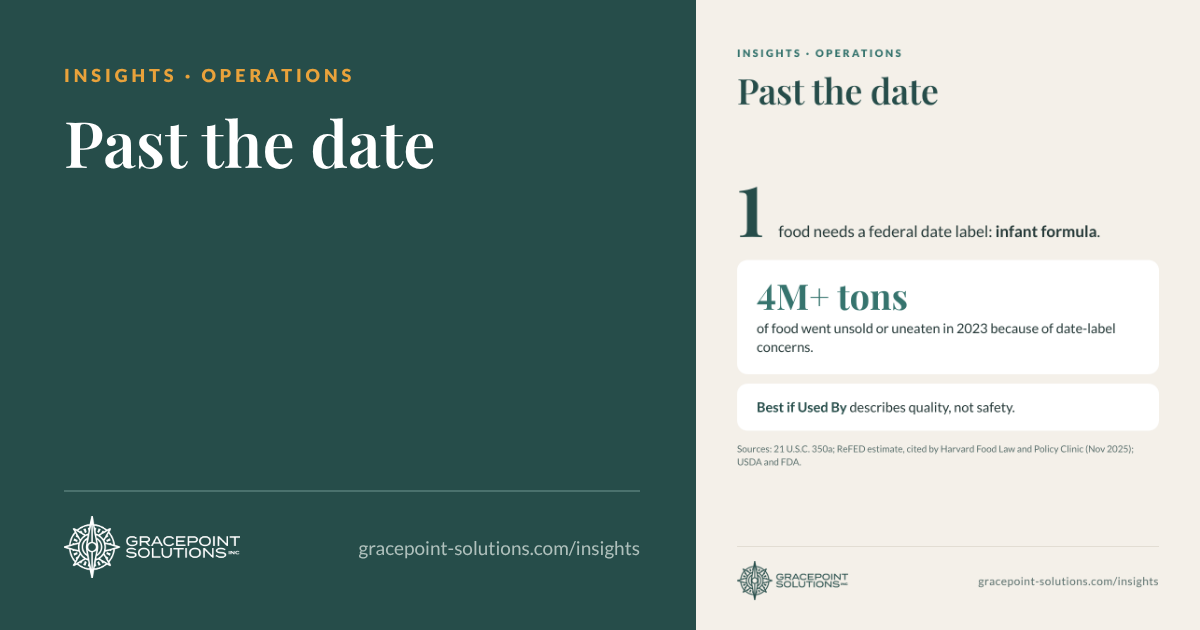
The answer usually has less to do with the date than people think. Federal law requires a date label on only one food, infant formula. Everything else carries a date the manufacturer chose to print, in whatever words it chose to use.
What the words mean
The U.S. Department of Agriculture and the Food and Drug Administration both recommend that manufacturers use "Best if Used By" for quality dates. FDA describes it as the date "after which quality may decline but the product may still be consumed." Under a voluntary industry initiative, "Use By" is meant for perishable foods where the date matters for safety.
On the shelf, volunteers see far more variety than that: Sell By, Best Before, Enjoy By, Freshest By. To someone sorting donations on a Saturday morning, every one of them sounds like a warning.
What the confusion costs
ReFED, a nonprofit that tracks food waste, estimated that more than 4 million tons of food went unsold or uneaten in 2023 because of date-label concerns, as cited in a November 2025 review by Harvard Law School’s Food Law and Policy Clinic.
The clinic reviewed what the public told USDA and FDA after the agencies asked about date labeling in December 2024. The agencies received 6,914 comments. Food banks and food recovery organizations wrote 15 of the organizational comments, and their message was consistent: donors hesitate to give near-date food, and recovery groups hesitate to accept it.
"Uncertainty over food safety often forces us to discard donations that could otherwise nourish our communities," Food Finders wrote in its comment.
The clinic recommended that the agencies standardize labels to two phrases, one for quality and one for safety, and noted that they have the authority to do so without new legislation. The Food Date Labeling Act of 2025, which would write that standard into law, has not advanced.
Keeping good food moving
Until the labels change, a pantry’s own habits do most of the work:
- Put the policy in writing. If your regional food bank has shelf-life guidance for partner agencies, ask for a copy and post it where volunteers sort.
- Treat infant formula as the exception. It’s the one food with a federally required date, so it goes out before that date or not at all.
- Move older stock first. When every item carries the day it arrived, the oldest cases are easy to find.
- Record what you discard and why. A simple log turns "we throw out a lot of bread" into a number a donor or partner can help with.
GracePoint gives every donated item a timestamped record at intake, so a coordinator can see what has been on the shelf longest and send it out first. The same record shows donors how their gifts moved, from the day they arrived to the day they went home with a family.
How much of what your pantry set aside last month was food a neighbor would have been glad to take home?
Sources: USDA and FDA, request for information on food date labeling (December 2024); Harvard Law School Food Law and Policy Clinic, "Checking In on Food Date Labeling" (November 2025); 21 U.S.C. 350a.
See real-time inventory visibility in action
GracePoint Solutions deploys in under 30 minutes — no IT team required. Book a demo to see what coordinated visibility looks like for your network.
Book a Demo